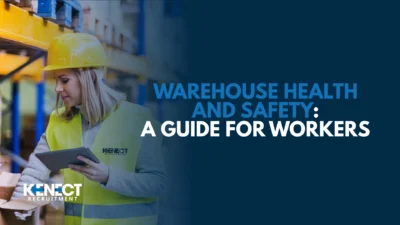
Understanding health and safety before starting a warehouse role is vital. Whether you’re new to the industry or looking to refresh your knowledge, knowing the key risks and how to manage them keeps you and your colleagues safe every single day.
Warehouses are fast-paced environments. Forklifts, heavy loads, repetitive tasks, and busy floors all create manageable hazards as long as everyone knows what to look out for. This guide covers the essentials.
Why warehouse health and safety matters
The Health and Safety Executive (HSE) consistently identifies warehousing and storage as a higher-risk sector. Injuries from manual handling, slips, trips, and vehicle-related incidents are among the most common in the industry.
However, the vast majority of warehouse injuries are preventable. Good warehouse health and safety practice isn’t about paperwork but about building habits that protect people. Employers have a legal duty to provide a safe workplace, and workers have a right to understand the risks they face.
Common warehouse hazards to be aware of
Understanding the risks in your environment is the first step. Here are the most frequent hazards found in warehouse settings.
Manual handling
Lifting, carrying, and moving heavy items causes more warehouse injuries than almost anything else. Poor technique puts strain on your back, shoulders, and joints over time. Always assess a load before you lift it, use mechanical aids where available, keep the load close to your body, and never twist while lifting. If something is too heavy, ask for help.
Slips, trips, and falls
Spillages, uneven floors, loose packaging, and cluttered walkways all create slip-and-trip hazards. Keep your working area clear, report spills immediately, and always use designated walkways. Wearing appropriate footwear (covered in more detail below) makes a significant difference.
Moving vehicles and machinery
Forklifts and other warehouse vehicles are one of the most serious hazards on any warehouse floor. Pedestrian and vehicle routes should always be clearly separated. Stay within marked walkways, make eye contact with forklift operators where possible, and never assume a vehicle driver has seen you.
Working at height
Picking from high racking, using mezzanine levels, or accessing overhead storage all carry a risk of falling objects and falls from height. Only use equipment you have been trained and authorised to use. Ensure racking is undamaged and report any structural concerns immediately.
Fire safety
Warehouses often store large quantities of flammable materials. Know the location of fire exits, fire extinguishers, and your assembly point before you start work. Keep emergency exits clear at all times and follow your site’s fire safety procedures without exception.
Personal Protective Equipment (PPE) in warehouses
Warehouse health and safety relies heavily on the correct use of PPE. Your employer should provide any required PPE free of charge, and you are responsible for wearing it correctly and reporting any damage.
Common PPE in warehouse roles includes:
- Safety footwear: steel-toe cap boots protect your feet from falling objects and heavy loads. Non-slip soles also reduce your risk of slips on warehouse floors.
- Hi-visibility clothing: keeps you visible to vehicle operators in busy environments. Often mandatory across the entire warehouse floor.
- Gloves: protect against cuts, abrasions, and temperature extremes depending on what you’re handling.
- Hard hats: required in areas where overhead work takes place or where falling objects are a risk.
- Ear protection: prolonged exposure to machinery noise causes long-term hearing damage. If your site exceeds noise exposure limits, ear protection is legally required.
For a full overview of your PPE rights and employer obligations, look at the HSE’s PPE guidance.
Manual handling best practice
Manual handling injuries are largely preventable with the right approach. Your employer should provide manual handling training as part of your induction. The key principles to follow are:
- Assess the load before you lift: is it too heavy, awkward, or unstable?
- Use mechanical handling aids wherever possible: trolleys, pallet trucks, and conveyors exist for a reason.
- Maintain a safe posture: bend your knees, keep your back straight, and hold the load close to your body.
- Never twist while lifting: move your feet instead of rotating your spine.
- Ask for help or use team lifting for anything beyond a safe limit.
Repetitive strain injuries often develop gradually. Report any discomfort or pain early and do not wait until it becomes a serious issue.
Your responsibilities as a warehouse worker
Warehouse health and safety are shared responsibilities. Your employer must provide a safe working environment, adequate training, and the right equipment. In return, you have a duty to:
- Follow all site rules, procedures, and safe systems of work
- Wear PPE as required and report any defects
- Report hazards, near misses, and accidents, no matter how minor they seem
- Attend any training provided and take it seriously
- Look out for your colleagues: safety is a team effort
If you ever feel unsafe or unsure about a task, you have the right to raise it with your supervisor or site manager. No job is worth risking your health.
Looking for a warehouse role?
Understanding warehouse health and safety puts you in a strong position as a candidate. It shows employers you take your responsibilities seriously and are ready to hit the ground running.
Browse our latest jobs and take the next step in your career.